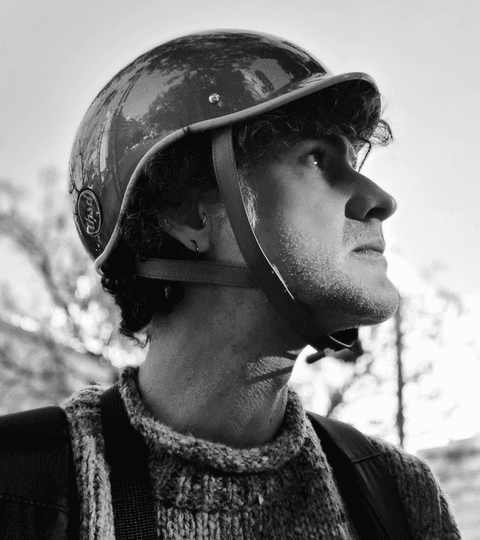
Born in Sabadell, surviving in the Gràcia neighborhood (Barcelona). Father of Elna and Fèlix. Graduate in sociology from Universität Münster (Germany).
I have spent two decades combining art with critical analysis of reality. My academic training was complemented by the Master's in Creative Documentary from Pompeu Fabra University. I also trained as a camera operator at CIFO (Hospitalet). I have a postgraduate degree in visual effects and another in literary translation (both from IDEC-UPF); Pedagogical Aptitude Course (Autonomous University of Barcelona).
My trajectory as an artist began in 2003 through a year-and-a-half stay in Paris. It is in this context that I began using the anonymous identity Metromuster. In 2005 I made my first documentary, within the framework of my sociology final project (Magister Artium): Rotes Land (Red Land), a research on the effects of the opening of the Republic of Vietnam to the globalized capitalist economy (known as Đổi mới). In 2007 I began to be part of the Barcelona collective Enmedio, where I came into contact with artivism, Free Culture and the subversive narratives that emerge from so-called communication guerrilla warfare.
From 2008 onwards I began making a trilogy of short documentaries about fighting women from Barcelona, within the framework of Canal 33's Taller.doc program: L'últim vestit de la Júlia, Bar Leo and La Rosa no està sola. A year later, Metromuster was formalized as an audiovisual production company and I embarked on the realization of the project NO-RES, life and death of a space in three acts, which I directed alone. From this moment on, Metromuster would become the platform through which I would develop a filmography committed to historical memory and current emancipation social movements. The resulting cinema is characterized by contrasting official narratives with independent investigations, giving voice to silenced stories and building bridges between struggles, narratives and art. Three fundamental objectives have guided my work: the unmasking of structural and institutional violence, commitment to oppressed subjects, and free access to culture. The active task of making documentaries has always been accompanied by deep reflection on the tensions between reality and truth, questioning the limits between documentary and fiction.
My cinematographic career is deeply linked to my social activism, which began with the anti-globalization movement of the first decade of the 2000s and culminated when I became a member of the audiovisual commission of 15M in Barcelona, in 2011. This experience has allowed me to establish strong ties with political and social collectives with whom I continue to collaborate today.
Throughout the 2010s, I produced and co-directed several documentaries that had a great impact on Catalan and Spanish society, among which Ciutat Morta, Tarajal – dismantling impunity at the southern border and Idrissa, chronicle of any death stand out. I also became involved in creating communication campaigns linked to social movements, political parties or third sector entities that combine communication guerrilla strategies with narrative registers typical of fiction.
Since 2020, my activity has expanded to the academic field as a lecturer at the Open University of Catalonia (UOC), where I have created the Transmedia Journalism Workshop together with professor Anna Clua and from where I have written several didactic modules on transmedia narratives and social transformation documentary.
Currently, I am developing, together with the production company Polar Star Films and OLD Media, La Força, my first fiction project, which explores the experience of philosopher Simone Weil as a militiawoman in the Durruti Column during the Spanish Civil War. This work, which has passed through prestigious laboratories such as the New York Film Academy, the Torino Film Lab or the Mediterranean Film Institute, is the result of exhaustive historical research supported by the Democratic Memorial of Catalonia. This project represents a natural evolution in my career, where fiction is presented as a necessary tool for a story about the real in times of post-truth and as historical reflection filtered by a will for social transformation. For writing the script of La Força I have the collaboration of American screenwriter Pamela Katz (Hannah Arendt, 2016).
The research necessary for writing the script of La Força has given rise to the essay Viure la Força: Simone Weil i la Columna Durruti, which has been published by Descontrol publishing house. Read the reviews of the book.